

Restore the finish. Keep the character.
Professional stone floor stripping, deep cleaning, honing, polishing and sealing for worn, dull or scratched natural stone.
Rated 5.0 on Google from 60+ reviews
- Limestone, slate, travertine and flagstone
- Matt, satin or polished finishes where suitable
- Optional repairs and filling, quoted after inspection

More than a deep clean
When mopping no longer changes the floor, the surface may need restoring.
Everyday traffic, grit, spills and unsuitable cleaning products can leave natural stone dull, patchy or difficult to keep clean. Old coatings may yellow or trap soil, while scratches and etch marks scatter light and take away the finish.
Damage goes further than the finish in places. Holes, chips, cracked tiles and open or crumbling joints are common in older floors, and polishing around them only makes them more obvious, so we look for them at inspection.
Restoration itself runs in three stages: strip and deep clean, restore the finish, then seal and protect. Where the inspection finds damage, repair and filling is quoted separately as an optional add-on rather than assumed.
- Dull or uneven appearance
- Ingrained dirt and dark grout lines
- Light scratches and etch marks
- Holes, chips, cracks and lost grout
- Failed, patchy or tired sealers
Recent floor care
The finish is in the preparation.
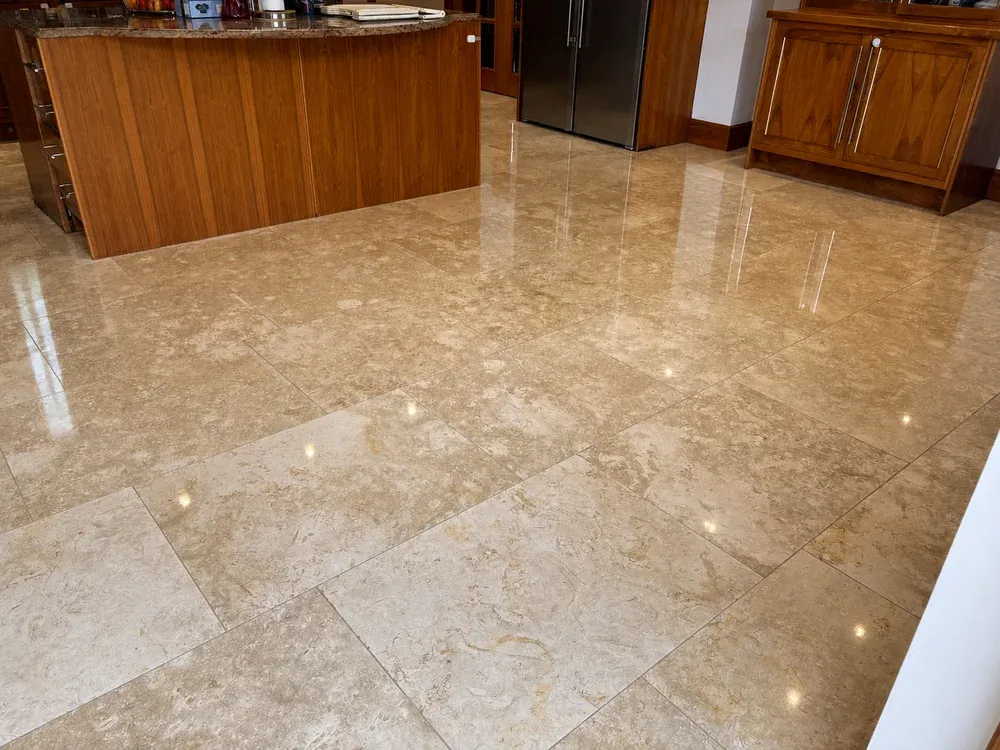
A restored stone floor should read evenly right across the room, with no patches where the light catches one area differently to the next.


Optional add-on
Repair and filling, where the inspection finds it is needed.
Repair is not one of the three restoration stages. Where we find damage at inspection we quote it separately, and carry it out before the floor is finished — damaged stone does not polish out, and a new finish only makes it easier to see.
-
Chips & broken corners
Lost edges and corners are rebuilt with a colour-matched mortar or resin, then shaped and polished back level with the surrounding tile.
-
Holes & pitting
Old fixing holes, pitted travertine and blown patches are filled and levelled so they stop collecting dirt and catching a mop.
-
Cracked tiles
Cracks are opened up, cleaned, stabilised and filled. Where the cause is movement in the subfloor we will say so and price it honestly rather than cover it over.
-
Lost & crumbling grout
Failed joints are raked out and replaced with a matched grout. On an old floor this is very often what is actually making it look tired.
-
Loose & hollow tiles
Tiles that rock or sound hollow are lifted and re-bedded before restoration, so the repair stays put instead of returning in a few months.
-
Previous poor repairs
Mismatched filler, cement smears and resin left proud of the surface are cut back and redone so the floor reads as one surface again.
From a job like yours
We had already priced up replacing the lot. This came to a fraction of that and we have kept the original stone.
Free floor survey
Get a fixed price for your floor.
Tell us what you know and add photos if you have them. We will confirm the next step and arrange a survey where needed.
A treatment matched to the floor
Three stages, matched to the floor.
Every restoration runs in the same three stages. The survey specifies the least invasive route to the finish you want, and adds repair and filling only where the floor turns out to need it.
-
 Stage 01
Strip & deep clean
Surface soil, residues and unsuitable coatings come off with products and agitation matched to the stone, taking the floor back to the material itself.
-
 Stage 02
Restore the finish
Progressive diamond pads reduce wear, scratches and uneven areas and bring the stone to the agreed matt, satin or polished sheen.
-
 Stage 03
Seal & protect
A sealer chosen for the stone and how the room is used goes on last, so the finish resists staining and day-to-day care stays simple.
What happens next
A careful process from survey to handover.
Survey the floor
Protect the room
Repair if needed
Restore in stages
Seal where needed
Inspect & hand over

Stone types & spaces
From a farmhouse flagstone hallway to a honed limestone kitchen.
Natural materials vary enormously, even within the same stone family. We match the products, tooling and finish to the surface in front of us rather than relying on one standard method.
- Limestone and travertine
- Slate and flagstone
- Terracotta and quarry tile
- Sandstone and natural stone hearths
- Terrazzo and composite stone
- Hole, chip and crack repairs (optional add-on)
- Domestic and commercial floors
Stone floor restoration questions.
If you are unsure what the floor is or which treatment it needs, send a few photographs. We will help you narrow it down.
Prefer to talk it through?
Describe the stone, the room and the problem. A quick conversation often identifies the sensible next step.
Can a very old or badly worn stone floor be restored?
Often, yes. Natural stone usually has more usable surface below the worn finish. We assess deep damage, loose tiles and previous treatments before explaining what can realistically be improved.
What is the difference between cleaning, honing and polishing?
Cleaning removes soil and residues. Honing mechanically refines the top of the stone to reduce surface damage and create a smooth matt or satin finish. Polishing continues that refinement to a higher sheen on suitable stones.
Can you repair holes, chips and cracks in a stone floor?
Usually, yes, as an optional add-on rather than part of the standard three-stage restoration. Holes, chips and lost corners are filled with a colour-matched mortar or resin, left to cure, then levelled and polished in with the surrounding stone. Cracks can normally be stabilised and filled, though a crack caused by movement in the subfloor will come back unless that is dealt with first. We will tell you which sort you have at survey.
Will a repair be invisible?
The aim is for it to disappear at normal standing height rather than under close inspection. Natural stone varies in colour and pattern across a single tile, so a good repair is matched to its immediate surroundings. We will show you what to expect before agreeing the work, and where a tile is beyond repair we will say so and price replacing it instead.
Does every stone floor need sealing?
No. The right treatment depends on the material, porosity, location and finish. Where a sealer will help, we select one that suits the stone rather than applying the same product to every floor.
Can I choose a matt, satin or polished finish?
Usually, but not every stone supports every finish. We will show or explain the realistic options during the survey and agree the finish before restoration begins.
How long will the work take?
That depends on the floor area, its condition and the number of treatment stages. Your written quote will set out the expected programme and when the room can go back into use.
How should I look after the floor afterwards?
We leave aftercare advice for the exact stone and finish. In most cases that means regular dry soil removal, a suitable pH-neutral cleaner and dealing with spills promptly.
Let’s see what your stone floor can become.
Send photographs for an initial view, or book a floor survey anywhere across Bristol, Bath and South Gloucestershire.