

A worn worktop is usually a finish problem, not a worktop problem.
Cleaning, honing, polishing and sealing for granite, marble, quartz and limestone, carried out in your kitchen and finished in a day for most tops.
Rated 5.0 on Google from 60+ reviews
- Granite, marble, quartz and limestone
- Etch marks, limescale and worn sealer
- Fixed written quote before work starts

Why it stopped looking new
The stone is fine. The top half-millimetre of it is not.
A worktop takes more abuse in a week than most floors take in a month, and all of it in the same three places: the sink, the hob and the spot where the kettle lives. Lemon juice, wine, vinegar and descaler eat into marble and limestone and leave dull rings that no amount of cleaning will shift. Limescale builds a hard grey collar around the taps. Granite goes patchy where the sealer has worn through and the oil from cooking has started soaking in.
Almost none of that is damage to the slab. It sits in the surface, and the surface can be taken back: cleaned, re-honed and re-polished with diamond abrasives, then sealed so it stays that way. Replacing a worktop that only needs restoring is an expensive way to solve the wrong problem.
- Dull rings and etch marks from acidic spills
- Limescale and water staining around taps and sinks
- Failed sealer, oil marks and darkening near the hob
Recent worktop work
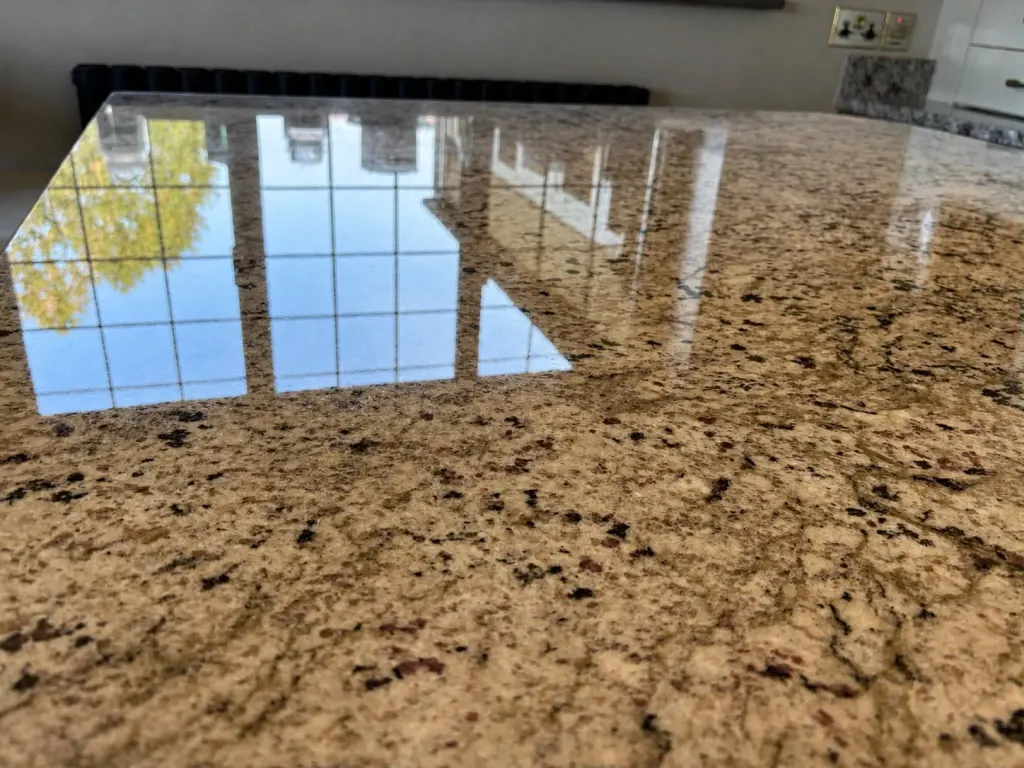
A polished top should give you the window back.
Granite worktops photographed on site after restoration. A finished polish reflects cleanly and evenly. Patchy reflections are the first sign a top needs attention.


Free worktop survey
Get a fixed price for your worktops.
Tell us the material if you know it and add photographs of the dull or marked areas. We will confirm the next step and arrange a survey where needed.
A treatment matched to the material
Clean it, then bring the finish back.
Granite, marble, quartz and limestone all behave differently under an abrasive, and quartz will not tolerate what granite shrugs off. The survey decides how far the top needs to be taken, and no further.
-
 Stage 01
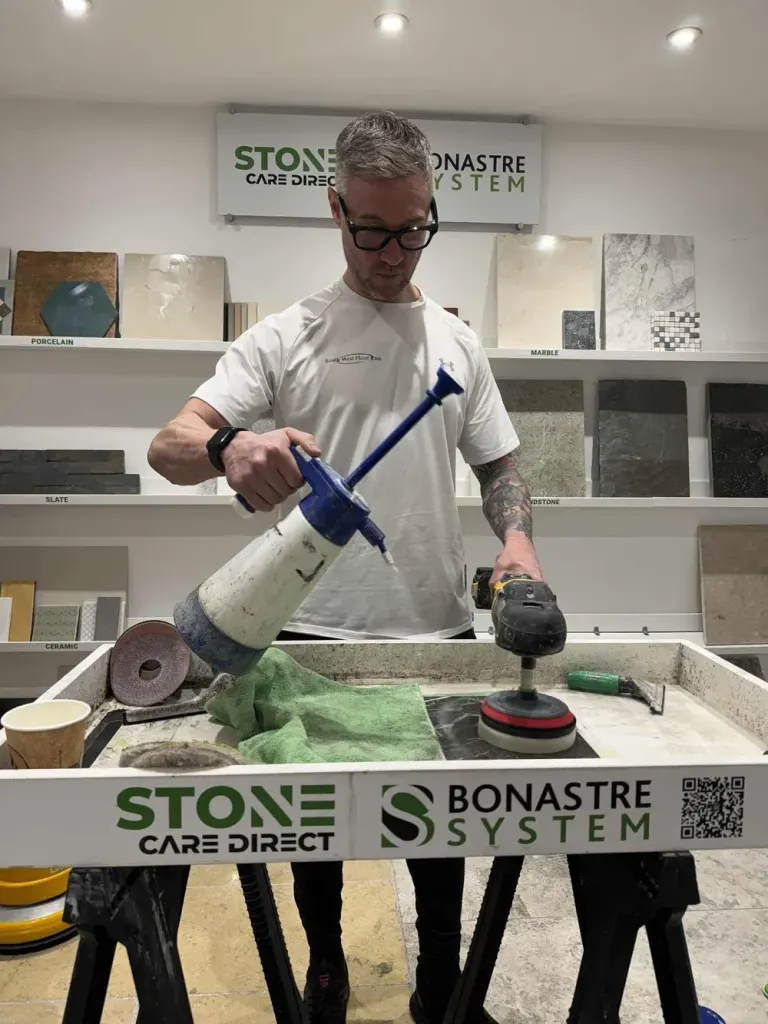
Deep clean & descale
Old sealer residue, cooking oil and soap film come off, and limescale is removed from around the taps and sink without etching the stone underneath.
-
 Stage 02
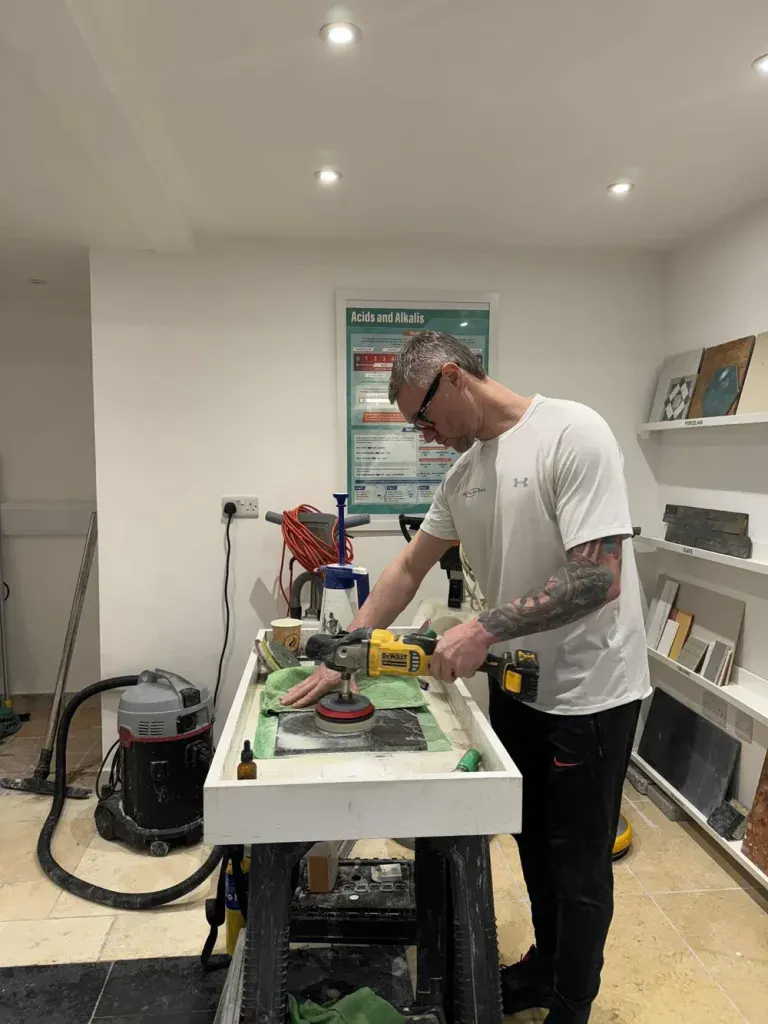
Restore the finish
Diamond abrasives take out etch marks and scratches and rebuild the finish to matt, satin or full polish, edges and cut-outs included.
-
 Stage 03
Seal & protect
An impregnating sealer suited to the material goes in to keep the finish there, and we leave the list of cleaners to keep away from it.
What happens next
A careful process from survey to handover.
Identify the material
Protect the kitchen
Restore the finish
Seal & hand over
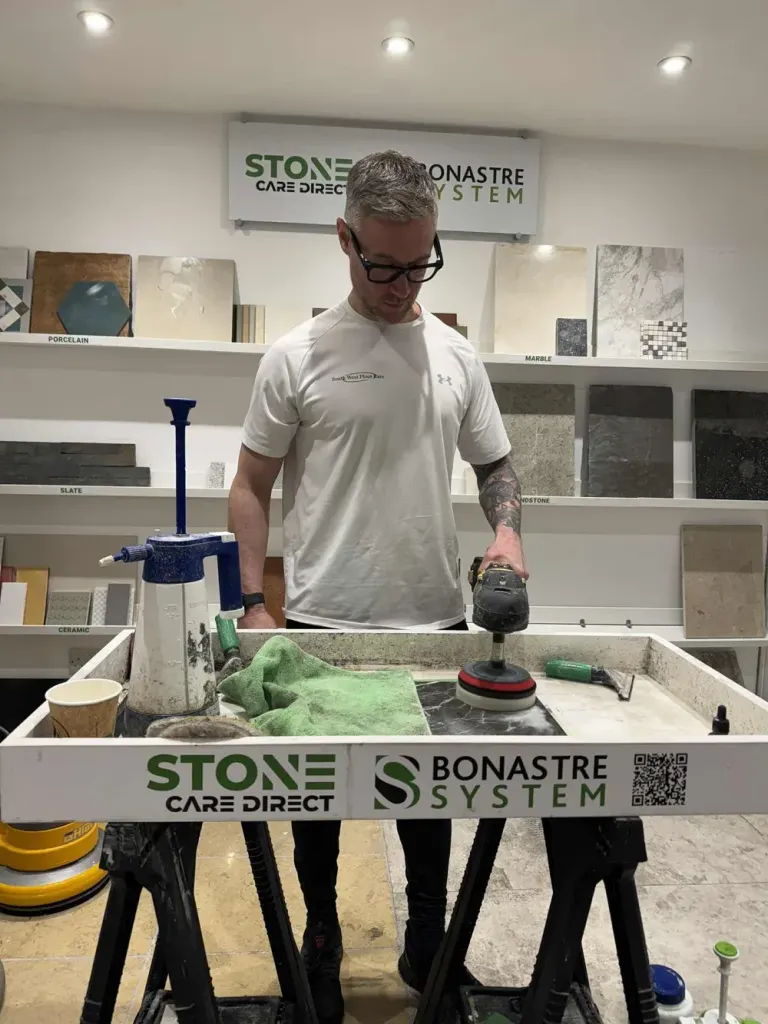
Materials & surfaces
Granite and quartz forgive a lot. Marble and limestone forgive nothing.
Granite is hard and takes a deep polish, but its sealer wears through around the sink and hob. Marble and limestone are calcite, so every acidic spill etches them, which is why they dull first and worst, and also why honing brings them back so well. Quartz is stone held in resin: it cannot be worked like natural stone and heat will scorch it, so it needs a gentler route. We work out which of those we are standing at before choosing a pad.
- Granite worktops, islands and breakfast bars
- Marble worktops, pastry slabs and vanity tops
- Quartz and engineered stone
- Limestone and travertine surfaces
- Upstands, splashbacks, window sills and sink cut-outs
- Kitchens, utility rooms, bathrooms and bars
Worktop restoration questions.
If you are not sure whether you have granite, quartz or something else, send a photograph and a close-up of the marks. That usually settles it.
Prefer to talk it through?
Tell us the material if you know it, the rough length of the run, and what has gone wrong. We can normally give you a sensible answer from photographs.
Can a dull, etched worktop really be brought back?
Yes, and it is the most common job we do. Etch marks and dull patches sit in the very top of the stone, so honing and re-polishing removes them and restores an even finish across the whole surface. Marble and limestone respond particularly well.
Do you have to take the worktop out?
No. Everything is done in place. The kitchen is masked and sheeted, water and dust are controlled at the machine, and most worktops are finished and back in use the same day.
Can quartz worktops be polished like granite?
Not in the same way. Quartz is stone bound in resin, so aggressive abrasives and heat damage it rather than refine it. We can deep clean it, remove staining and improve dulled or scratched areas, but a full re-polish is not possible on every quartz, and we will say so before quoting.
Why does my marble keep marking near the sink?
Because marble is calcite and reacts with acid. Lemon, vinegar, wine and most limescale removers etch it on contact, leaving a dull mark that is physical damage rather than a stain. Sealing slows staining but cannot stop etching. The fix is to hone the marks out and then keep acidic products off it.
Does a worktop need resealing, and how often?
Natural stone does. How often depends on the material and how hard the kitchen is used, typically every one to three years, and sooner around the sink and hob. We leave you a simple water test so you can check it yourself rather than guess.
Let’s get your worktops looking like the day they went in.
Send photographs for an initial view, or book a survey anywhere across Bristol, Bath and South Gloucestershire.